
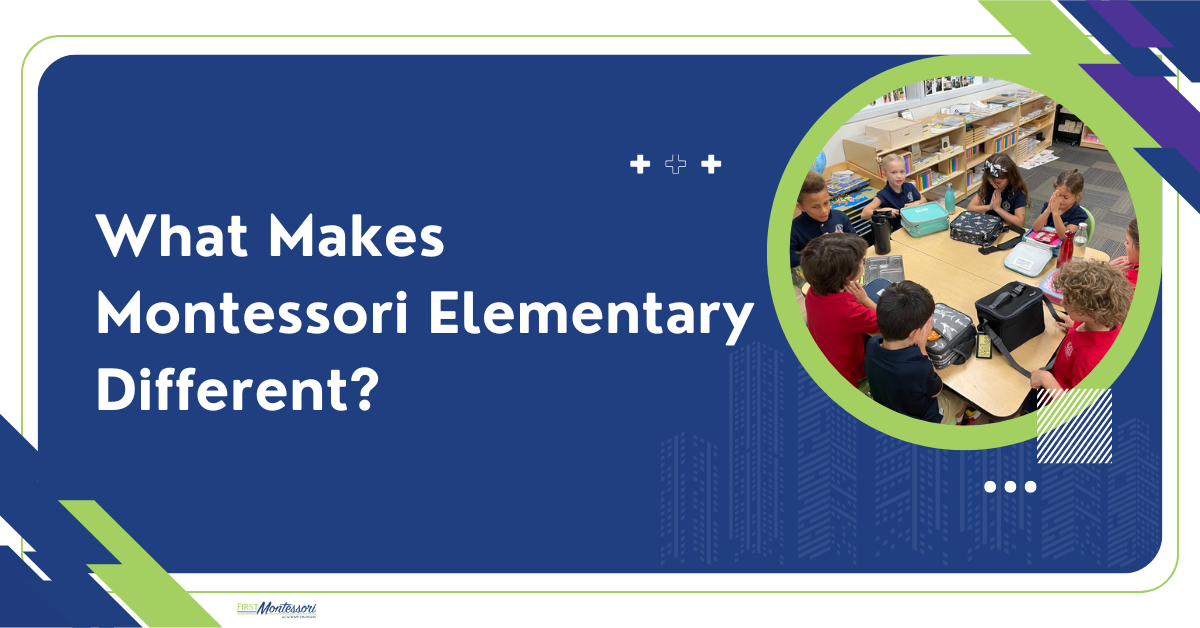
Does Montessori still work once children move beyond preschool? This is a common question for parents considering Montessori elementary education. Montessori is not simply a preschool approach that continues with older children. As children develop, the lessons, materials, responsibilities, and academic expectations become more advanced.
Montessori elementary education combines individualized academic guidance, hands-on work, mixed-age classrooms, connected subjects, collaboration, and increasing independence. Children receive structured lessons from teachers while also learning to manage their time, research questions, solve problems, and apply knowledge.
For parents comparing elementary school alternatives, understanding these differences can make it easier to decide whether Montessori fits their child’s needs. The goal is not to remove structure or academic expectations. It is to organize learning in a way that gives children increasing responsibility as they mature.
Montessori Elementary Is Designed for a New Developmental Stage
Elementary-age children often become interested in broader questions about how and why things work. They can use imagination and reasoning to explore ideas that go beyond basic facts.
Montessori education responds by expanding academic work into research, discussion, investigation, and connections between subjects.
A child may move from learning basic geographical facts to asking how geography affects where people live. A mathematics lesson may lead to questions about measurement, architecture, trade, or science.
The work becomes more complex, but the underlying principle remains similar. Teachers observe students and introduce lessons according to their development and readiness.
The difference is that Montessori elementary school students gradually take more responsibility for managing meaningful academic work.

Subjects Are Taught as Connected Ideas
Interdisciplinary learning is an important part of Montessori elementary education. Individual subjects remain important, but lessons can also show how different areas of knowledge relate to one another.
For example, a study of an ancient civilization might include:
- Reading historical accounts
- Mapping geographical regions
- Writing a research report
- Studying trade and measurement
- Exploring climate and natural resources
- Creating a historical timeline
- Presenting findings to classmates
Students still receive focused instruction in mathematics, reading, writing, grammar, science, geography, and other subjects. The difference is that they may also explore how those subjects connect.
This can help children see academic knowledge as something they can use to investigate real questions rather than as a series of unrelated lessons.
Students Learn at an Individual Pace Within Clear Expectations
Individualized learning means instruction is adjusted to a student’s readiness, progress, and learning needs while maintaining established academic goals.
In a Montessori classroom, children do not necessarily complete the same lesson at exactly the same time. A teacher may give an individual mathematics lesson to one student while working with a small group on grammar.
Teachers monitor progress and introduce new lessons when students are ready. Children can also revisit skills that need more practice.
This does not mean students can avoid important academic work. Teachers track what children are learning and provide direction when work is unfinished or when a child needs additional support.
Individual pacing is therefore balanced with accountability.
Mixed-Age Classrooms Change How Students Learn Together
A mixed-age classroom brings children from different age groups together. Montessori elementary classrooms commonly span multiple years rather than placing every child in a separate age-based grade.
This creates opportunities for different types of learning.
Younger students can observe more advanced work. Older students may reinforce their own understanding by explaining a process or helping another student. Children can also develop leadership and responsibility through classroom activities.
Teachers may work with students over several years, allowing them to understand individual learning patterns and development.
However, a mixed-age classroom does not automatically create a strong learning environment. It still requires trained educators, clear expectations, appropriate materials, and effective classroom management.
Teachers Guide, Observe, and Track Progress
The Montessori teacher is not passive. The teacher’s role changes from relying mainly on whole-class instruction to combining lesson presentation, observation, progress monitoring, and individual guidance.
Teachers may:
- Present academic lessons
- Observe student understanding
- Maintain learning records
- Form small instructional groups
- Recommend follow-up activities
- Protect focused work periods
- Address unfinished work
- Support social problem-solving
- Communicate with families
The phrase “teacher as guide” can sometimes cause confusion. It does not mean children are expected to teach themselves.
Teachers remain responsible for introducing lessons, setting expectations, identifying gaps, and helping students move forward.
Students Have Longer Periods for Focused Work
Many Montessori classrooms provide extended work periods. Instead of changing subjects every short period, students may have time to complete several connected activities during a longer work cycle.
For example, a student might begin with a mathematics lesson, continue with independent practice, record their work, and then move into a research or writing activity.
A longer period can give students time to settle into a task, work through difficulty, ask for help, correct mistakes, or investigate a question further.
This does not mean every child will concentrate for the entire period without support. Teachers observe students and help them develop effective work habits over time.
Hands-On Materials Support More Advanced Academics
Hands-on education continues into the elementary years, but the purpose of Montessori materials changes as children become more capable of abstract thinking.
Students may use materials to explore:
- Place value
- Mathematical operations
- Fractions
- Geometry
- Grammar
- Sentence structure
- Geography
- Scientific classification
- Historical sequence
For example, a student may use a concrete mathematics material to understand a concept before moving toward calculations using symbols alone.
The materials are learning tools, not substitutes for reading, writing, calculation, discussion, or research. As students develop, they increasingly apply concepts without needing physical materials.
This progression helps explain how does Montessori teach elementary students. Concrete experiences can provide a foundation for increasingly abstract academic work.

Independence Includes Planning and Accountability
In preschool, independence may mean choosing an activity, completing it, and returning the materials. In elementary school, independence becomes more complex.
Students may learn to:
- Follow a work plan
- Prioritize assignments
- Gather materials
- Manage time
- Work without constant reminders
- Ask for help appropriately
- Record completed work
- Review and revise mistakes
- Participate in classroom responsibilities
Teachers gradually increase responsibility as students demonstrate readiness.
This means independent learning is not the same as working without support. Children are taught how to organize their work and are given guidance when they need it.
Student choice also does not mean the curriculum is optional. Academic expectations remain part of the classroom.
Collaboration Becomes More Important
Montessori education is sometimes described as highly individual, but elementary students also spend time working with others.
Collaborative learning may include:
- Research projects
- Science experiments
- Group presentations
- Peer editing
- Classroom discussions
- Problem-solving
- Community responsibilities
A student might independently research a topic before joining classmates to compare findings and prepare a presentation.
The goal is not to make every activity a group project. Children learn when to work independently and when cooperation is useful.
This balance can be particularly important as children develop communication, listening, negotiation, and responsibility skills.
How Does Montessori Elementary Compare With Traditional Elementary School?
The following comparison provides a general overview. Individual schools vary, so parents should ask how each program operates in practice.
| Montessori Elementary | Traditional Elementary |
| Mixed-age classroom | Usually same-age grade level |
| Individual and small-group lessons | More whole-class instruction |
| Flexible pacing within expectations | Shared class pacing |
| Connected subject areas | Subjects often taught in separate blocks |
| Longer work periods | More frequent scheduled transitions |
| Hands-on materials followed by abstraction | Greater reliance on textbooks or digital resources |
| Student planning and choice | Teacher-assigned sequence |
| Teacher serves as guide and instructor | Teacher commonly leads the full class |
Neither model should be judged solely from a comparison table. Classroom quality, teacher preparation, curriculum, school culture, and the individual child all matter.
Is Montessori Elementary Academically Structured?
Yes. Montessori elementary programs have academic subjects, lessons, expectations, routines, and methods for monitoring student progress.
The difference is how instruction is organized.
Students may have choices about the order or timing of some work, but those choices exist within established responsibilities. Teachers present lessons, monitor progress, and address unfinished work.
A child who needs additional support may receive another individual lesson or work with a small group. A child who is ready to move ahead may receive a more advanced lesson.
This structure is important when parents ask, is Montessori elementary academically rigorous? The answer depends on the individual school’s curriculum and implementation, but Montessori itself does not mean a child receives less academic instruction.
Which Children May Appreciate Montessori Elementary?
Montessori elementary may appeal to children who enjoy asking questions, exploring topics deeply, working with their hands, solving problems, collaborating with peers, or taking responsibility for meaningful tasks.
However, a child does not need to arrive at school already highly independent.
Independence is developed through teaching, repetition, routines, and appropriate responsibility. Teachers support children as they learn how to organize their work and manage increasing expectations.
Parents asking is Montessori right for my child should therefore consider the actual school environment rather than relying on general assumptions about Montessori students.
What Should Parents Look for in a Montessori Elementary School?
When visiting a school, parents should look for:
- Montessori-trained elementary educators
- Clear academic expectations
- Purposeful Montessori materials
- A prepared and orderly environment
- Mixed-age classroom structure
- Individual and small-group lessons
- Systems for monitoring progress
- Meaningful student work plans
- Research and collaboration opportunities
- Respectful teacher-child interactions
- Strong communication with families
- A clear transition process for new students
Parents should observe the classroom if possible. Look at what students are actually doing, how teachers provide guidance, and how independence is balanced with academic responsibility.
Montessori Elementary Education in Sarasota
Families comparing a Montessori school Sarasota options may be looking for an alternative to larger classroom settings, continuity after Montessori preschool, individual academic guidance, or a private and faith-based environment.
First Montessori Academy offers Montessori education in downtown Sarasota for children from 18 months through age 12. Its programs include elementary education for children in the elementary age range, allowing families to continue with Montessori beyond the preschool years.
The school describes its approach as focusing on academic, social, emotional, physical, and spiritual development. Families considering a Montessori elementary school in Sarasota can visit the campus to observe the classroom environment and discuss the school’s approach with educators.
For parents comparing a private elementary school Sarasota families may consider, a school tour can provide more useful information than a website alone.
Observe a Montessori Elementary Classroom
A school visit can help parents see how individual lessons, collaborative work, classroom routines, and student independence function together. Families can schedule a tour of First Montessori Academy to learn more about Montessori elementary education in Sarasota.
Frequently Asked Questions
Is Montessori elementary only for children who attended Montessori preschool?
No. Children can enter Montessori during the elementary years. Students who are new to Montessori may need time and guidance to adjust to independent work, mixed-age classrooms, and different routines. Parents should ask schools how they support children who are transitioning from another educational setting.
Do Montessori elementary students receive grades?
Assessment practices vary by school. Montessori teachers may use observation, work records, portfolios, conferences, and academic assessments to understand progress. Parents should ask how a particular school documents achievement and communicates academic development to families.
Does Montessori elementary include homework?
Homework policies vary between schools. Some Montessori programs place greater emphasis on completing meaningful work during the school day, while others may assign reading, practice, or longer-term projects. Parents should ask how homework fits into the school’s overall curriculum and expectations.
Can Montessori students transition to a traditional school?
Yes. Students can transition between educational settings, although the experience varies according to the child, grade level, school expectations, and support available. Families considering a future move should discuss academic requirements and transition planning with both schools.
Is Montessori elementary less structured?
No. Montessori elementary classrooms have routines, academic expectations, teacher guidance, and classroom responsibilities. Students may have more choice in how they organize some work, but that choice exists within established requirements. Independence is developed gradually rather than assumed from the beginning.
Conclusion
Montessori elementary differs from traditional elementary instruction primarily in how learning is organized, rather than in whether academics are taught. Students receive individual and small-group lessons, work with hands-on materials, explore connections between subjects, and gradually take greater responsibility for their work.
Mixed-age classrooms can support peer learning, while longer work periods provide time for research, practice, discussion, and problem-solving. Teachers remain actively involved by presenting lessons, monitoring progress, and providing guidance.
For parents considering elementary school alternatives, the most useful step is to visit a classroom and see these principles in practice. Ask how the school monitors academic progress, balances independence with accountability, and supports children who need additional guidance.
Families in Sarasota can learn more about First Montessori Academy’s elementary program or schedule a tour to see how Montessori elementary education works in practice.

